Who could age out of the UK-EU youth visa before it opens?
Applicants must be 18 to 31 on the first day of their own visa. The UK and EU aim to have the first travelers abroad by January 2030.
Someone who turned 30 on Friday has until November 19, 2028, to start a youth visa under the deal Britain and the European Union struck in Brussels. The next day is their 32nd birthday. Friday’s summit ended without an opening date.

Photo credit
Prime Minister Andy Burnham and the EU leaders set out two dates in their joint statement on November 20. They want the Youth Experience Scheme agreement to take effect by 2028. They aim to have the first young people traveling by January 2030. Even if the agreement takes effect early in 2028, the first travelers might still be packing their bags well after that November birthday.
The Cabinet Office says applicants must be between 18 and 31 on the first day of the visa. Sending in paperwork at 31 won’t save a place for someone whose visa begins at 32. For a teenager the same wait could work the other way. Someone turning 16 on the day of the summit would be 19 in January 2030, old enough to spend a year working abroad under a deal they heard about at 16.
A year in one country before moving to the next
There will be up to 100,000 places a year for British citizens going to the EU and another 100,000 for EU citizens coming to Britain. A Briton who wants to live in France applies to France. The countries taking part will divide their shares according to population, so a British applicant set on one destination can’t count on having all 100,000 places to choose from.
There is no requirement for two people to swap. A young Londoner can take a place without waiting for someone in Lyon to head the other way. British officials estimate the scheme could add between 18,000 and 43,000 to UK net migration in its first year. Their calculation allows for Britons leaving and for people who would have come or gone on another visa anyway.

A British traveler who wants to live in both France and Spain could spend a year in France and then switch to Spain. A few months working in France followed by a winter living in Spain would be too quick. The deal requires 12 months of residence before a switch. The first permit runs for two years. Staying for a third would take an extension, and three countries is the most anyone could live in over the full stay.
A British tourist can generally spend 90 days in the Schengen area in any rolling 180-day period. Staying longer ordinarily means qualifying for a national route, often on the strength of a job offer or a place on a course. The new application asks what the person intends to do first. A young person could go to learn a language, then look for paid work once they can hold a conversation. Each destination can set limits on the jobs open to participants. The Cabinet Office says most participating EU countries expect to allow unrestricted access to work. The governments plan to publish the terms before they sign.
There are bills to pay before that first shift. An EU citizen heading to Britain would owe an application fee and a health surcharge set at three quarters of the full rate. A British citizen heading the other way would need comprehensive health cover. Applicants also have to show they can support themselves. Someone who has a child can travel on their own, but the permit gives them no right to bring that child as a dependant.
How 31 became the cutoff
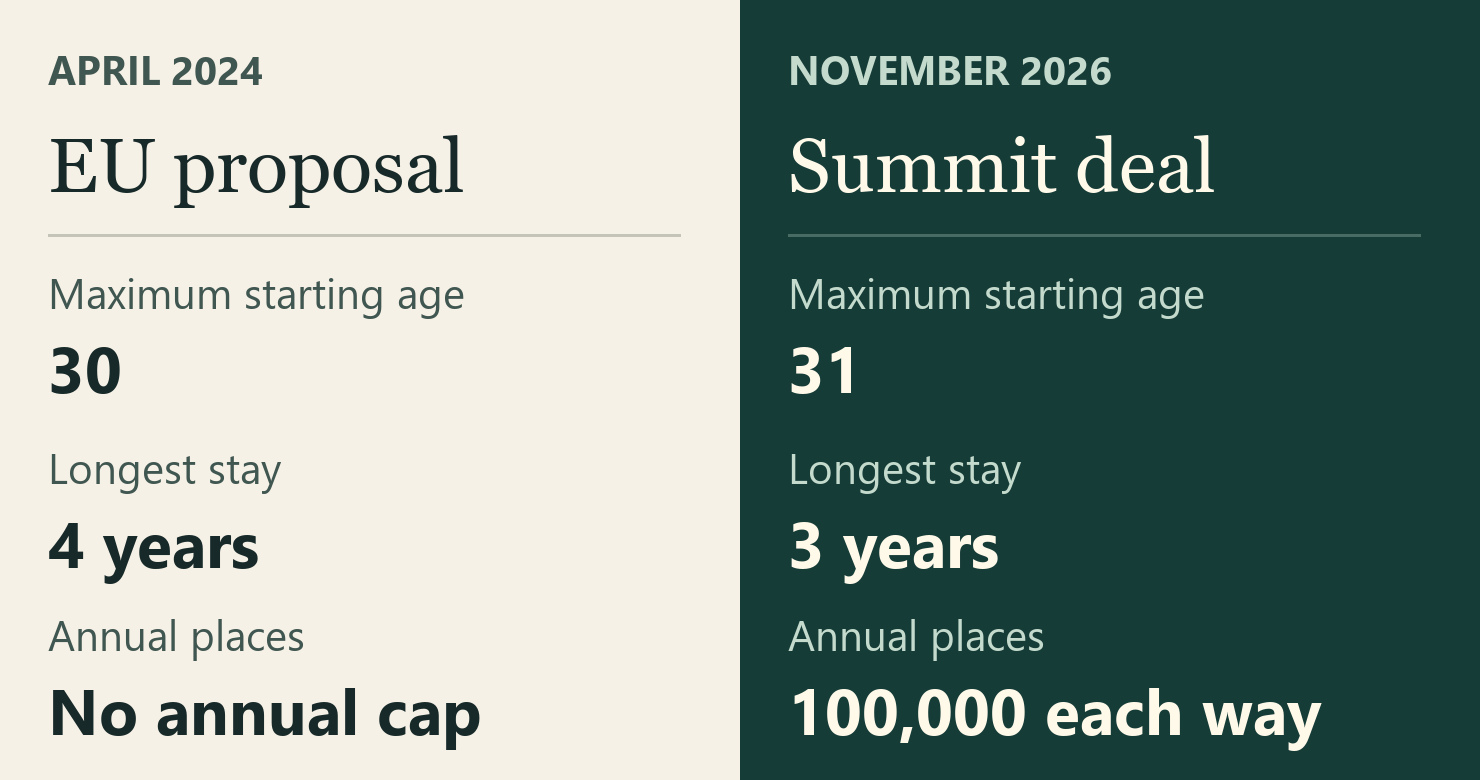
When the European Commission put its proposal on the table in April 2024, it wanted a maximum age of 30. A participant could have stayed for four years, and there would have been no annual quota. Britain had approached individual countries about making deals. The Commission wanted a young person’s chance to spend time in the UK to extend beyond whichever capitals London happened to approach.
The extra birthday in Friday’s agreement came at the end of the talks. The Guardian reported that negotiators raised the ceiling from 30 to 31 as they settled on the annual cap. A person who is already 31 when the scheme opens could get the initial two years. Turning 32 during that stay is a different matter from turning 32 the day before the visa begins. Nothing in the published age rule calls for cutting short a visa on the holder’s birthday.
What a university place would cost
For a student hoping to spend three years on a degree, the summit left a bigger expense open. The UK and EU gave themselves six months to negotiate tuition fees. Any fee agreement would cover students from the other side regardless of which immigration route they used. A French student accepted by a British university could therefore have money riding on those talks even if they never apply for a youth visa.

University College London enrolled about 3,400 EU students in 2023/24, down 38% from before the post-Brexit rules took effect. Across Britain, the drop was especially steep among people starting an undergraduate degree. Oxford’s Migration Observatory found that their numbers fell 67% between 2020/21 and 2023/24. Under the old arrangements an EU undergraduate in England could generally pay the same capped fee as a home student. In the first academic year after the change, the researchers found overseas undergraduate fees ranging from £11,400 to £32,000 a year.
Euronews reported that Britain favored a discount for EU students. The EU wants its students to pay the same rate as British ones. On Friday the Guardian reported that the two sides even disagreed over what would happen if the six months ran out without a fee deal. EU officials treated fees and the other summit agreements as a package. Downing Street said the deals could go ahead separately. A family pricing a British degree still has no new fee to put in its budget.
There is an earlier date for students who want a term abroad while enrolled at home. The UK is rejoining Erasmus+, and British institutions can seek funding for exchanges in the 2027/28 academic year. Colleges and universities could start applying for that funding on November 18, two days before the leaders met in Brussels.
Sources
- UK Cabinet Office · Youth Experience Scheme terms
- UK and EU · November 20 joint statement
- The Guardian · The final night of negotiations
- The Guardian · British and EU officials on tuition fees
- Euronews · The student fee dispute
- Oxford Migration Observatory · EU students in the UK after Brexit
- European Commission · The 2024 proposal
- House of Commons Library · How the youth mobility talks began
- UK government · Net migration estimates
- UK Department for Education · Erasmus+ placements