How checkers verified the Riemann hypothesis proof in Lean
Levent Alpöge released about 17 million lines of code. The teams checking it tested the logic and compared the result with an existing statement of the conjecture.
Independent checkers accepted a proof of the Riemann hypothesis that Levent Alpöge wrote in Lean, a system for expressing and checking mathematical proofs. They also confirmed that his result was the conjecture already defined in Mathlib, an existing library of Lean mathematics. The Lean and Mathlib communities announced the result on November 21. Alpöge had posted the Lean code the day before, with a four-page note describing how he worked with Anthropic's AI system Claude. The proof puts every nontrivial zero of the zeta function on the line with real part one-half. The Clay Mathematics Institute's Millennium Prize has a separate review process.
Photo credit
Where a zero would disprove it
There are 25 primes up to 100. With a much larger cutoff, it helps to have a formula that estimates the number without counting them one by one. The estimate can track the overall rise and still be off. Riemann wanted to know how large that error could get. In 1859, he connected it to the places where an expression now called the zeta function gives an answer of zero.
Draw a horizontal and a vertical axis. Make a mark half a unit to the right of the origin and three units up. Its real part is its horizontal coordinate: one-half. Now feed one such number into the zeta function. If the answer is zero, mark the original point. You'll get marks at minus two, minus four and the other negative even integers. Those are the so-called trivial zeros. Set them aside. Riemann's prediction is that every other mark lies on the vertical line halfway between zero and one. Their height can be different; their horizontal coordinate must be one-half.
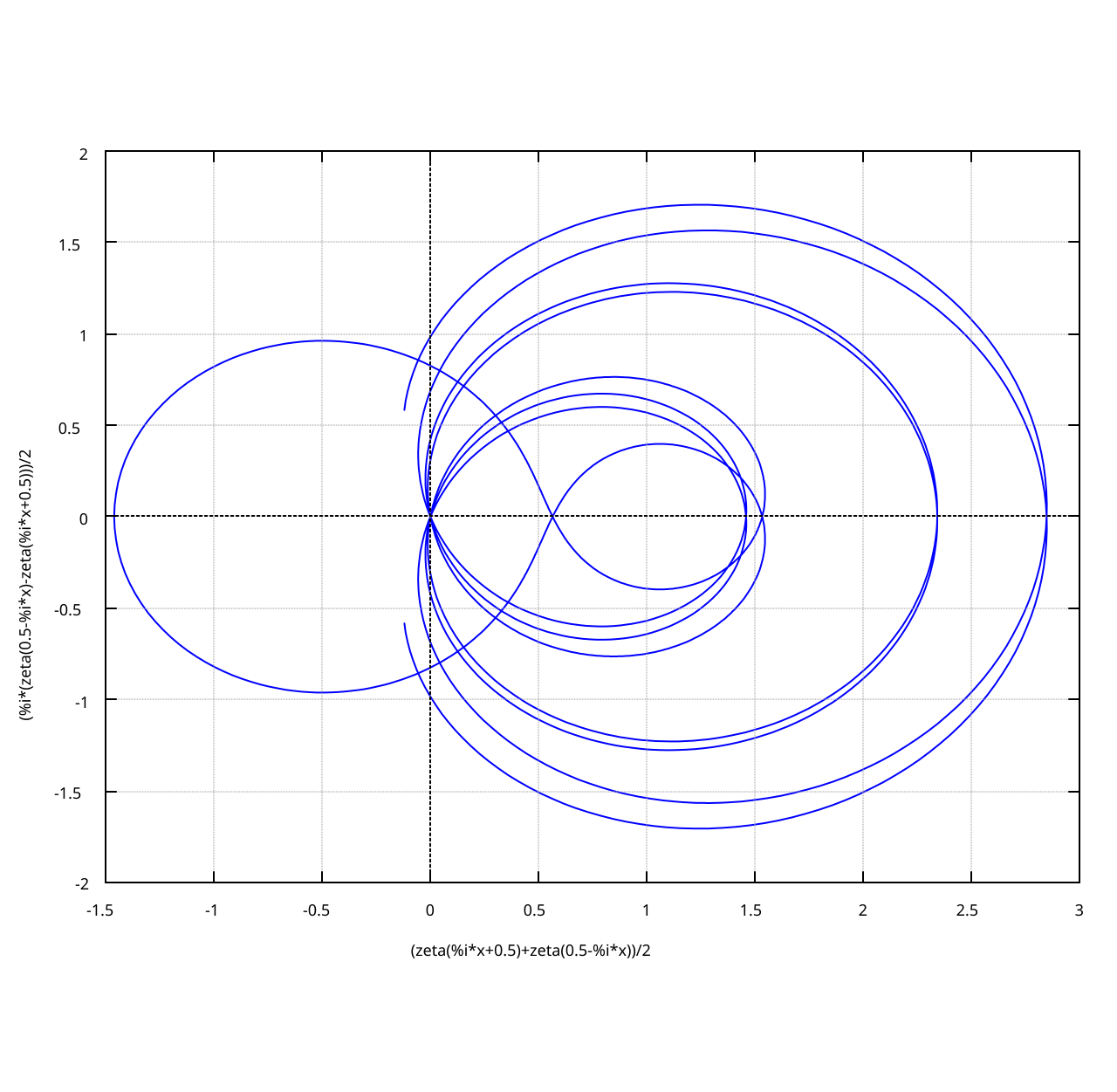
Figure credit
Now put a pencil mark anywhere on the three-quarters line. If the zeta function gave zero there, just that one point would disprove the conjecture. Finding a million zeros on the one-half line wouldn't tell you there were none elsewhere.
What the checkers compared
In the file used to test the conclusion, the version of the Riemann hypothesis comes from Mathlib, not from Alpöge's submission. The file draws only on Mathlib and doesn't need the submitted proof to state its target. MIT mathematician Andrew Sutherland published the statements in his verification record.
One version uses the name Mathlib gives the hypothesis. The other lists the conditions for a point on that page. It sets aside the negative even integers and the input 1. The zeta function blows up there; Mathlib assigns a value by convention, so the statement explicitly excludes it. If the function gives zero at any remaining input, the statement says that its horizontal coordinate is one-half. Neither version limits how high to look. A statement limited to any finite band of the page would not match. Two tools, Comparator and con-leche, checked the submitted conclusion against the target. Both found a match.
Sutherland's log says all 175,187 modules compiled. That counts files that built successfully, not the number of mathematical steps, and it doesn't tell you whether the conclusion is the one in the challenge file. Checking the argument is a separate job. A proof checker's kernel is the small piece that checks whether each logical step follows. In Sutherland's audit, two independently written kernels, nanoda and con-leche, accepted the full exported proof. The kernels read the exported proof. They don't have to run the tactics, the instructions that helped Lean construct that proof. Sutherland also checked what the five headline theorems asked Lean to take on faith. They used three standard Lean axioms and did not add a new assumption to get the conclusion.
In Sutherland's audit, the bundled versions of two checkers, con-leche and con-ron, stopped on a kind of definition they couldn't read. A newer con-leche build could read the type. It accepted the same export. The older runs ended without a verdict on the proof.
Three of the statements Sutherland checked concern Dirichlet L-functions, a family related to the zeta function. The familiar form of the generalized Riemann hypothesis for this family puts zeros whose real part is between 0 and 1 on the same one-half line. The audit doesn't establish an extension to Hecke L-functions or to the larger class known as automorphic L-functions.
You can see a consequence of the hypothesis without drawing any complex numbers. Add up the positive divisors of 6: 1, 2, 3 and 6 make 12. For a whole number above 5,040, Robin's inequality gives a ceiling for that sum based on the number you started with. A separate Lean project had formalized why that inequality and the Riemann hypothesis stand or fall together. Sutherland combined the two projects and checked the resulting bound without asking the final statement to mention zeta at all.
The proof Alpöge wants to write
Alpöge released code and a four-page note, not a paper laying out the argument. He wrote that he intends to explain it and expects it can be simplified. The checkers can verify steps in the proof; the files don't tell us who came up with them.
Rutgers mathematician Alex Kontorovich told the Associated Press that a written proof ordinarily lets mathematicians follow why one line leads to the next. NYU mathematician Maksym Radziwill drew a similar distinction in an email reported by Quanta: he separated valid operations on symbols from understanding the mathematical reason a result is true. Their remarks concern what another mathematician could learn from a written proof.
The Clay Mathematics Institute's rules don't let anyone submit a solution directly. Before it considers awarding the prize, the solution has to appear in a qualifying outlet, at least two years have to pass after that publication, and the mathematics community has to accept the result. The November 21 announcement came from Lean and Mathlib, not Clay.
Alpöge's four-page note gives a reader one place to begin. For a sum with 100 terms, the rule Claude suggested would call for a chain of 10 operations known as theta lifts, Alpöge writes. For a sum with 10,000 terms, it would call for 100. A written proof could show why its length grows with the square root of the number of terms.
Sources
- Levent Alpöge's release note: First page: scope, role of Claude in his own account and the square-root chain choice.
- Lean and Mathlib communities, Lean community blog: Joint verification; numbered criteria 1–4 distinguish definition, build, exact statement comparison and validity of the exported proof.
- Andrew Sutherland, MIT verification files: The theorem statements, axiom audit and checker runs. The Arithmetic consequences section documents the separate test using Robin's inequality.
- Hallie Golden, Associated Press: Interview with Rutgers mathematician Alex Kontorovich about what a readable proof supplies to another mathematician.
- Konstantin Kakaes, Quanta Magazine: Nov. 20 update As mathematicians race to verify AI Riemann proof, a human proof emerges: separately obtained email from NYU’s Maksym Radziwiłł on formal validity versus mathematical understanding.
- José Olivares, The Guardian: November 21 timing and announcement of verified status, cross-checked against joint statement.
- Clay Mathematics Institute: Historical origin and prime-count deviation connection.
- Clay Mathematics Institute: Prize rules: qualifying outlet, two elapsed years and general acceptance.