Grand Theft Auto VI review | At home with Jason and Lucia
GTA VI is at its best when Jason and Lucia are still robbing small stores and you get to decide when they’ve taken enough.

One of the better reasons to play Grand Theft Auto VI is a piece of flat-pack furniture. Jason and Lucia can spend an evening on the floor putting a coffee table together. You get a little heart for helping. It’s an absurdly modest thing for Rockstar to have built into a game where the same two people can rob a bank. It also makes a pretty good case for the bank job. These two have a home to go back to, and by the time the shooting starts there’s something you’d like them both to live long enough to enjoy.
GTA VI is worth playing for that couple. The heists give them interesting work to do together, and Leonida is full of places worth taking them once the work is done.
Moving in with Jason and Lucia
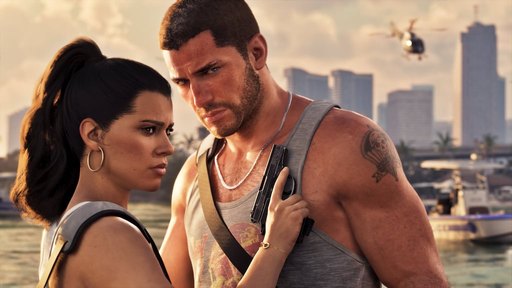
Lucia comes out of prison to find Jason getting by in the Keys, doing jobs for a man at the marina. He has a house on stilts and fairly limited ambitions for the day. She has been stealing cars since she was fourteen. Put them in a scene together and it’s usually Lucia you want to listen to. Jason can take so long to give so little away that some of his employers might reasonably wonder whether he heard the assignment. Around Lucia, his quiet makes more sense. She can tease him, and he’s comfortable letting her.
Giving the player both parts is a considerable improvement on having one of them spend the story at home worrying about the other. You can go out separately, switch between them, or call the other one over. They have things to do as a couple that would sound dismal on the back of a game box. You can sit on the couch and talk. At the gym they cheer each other through a set. The relationship meter is fairly easy to please, which is just as well. Imagine having to grind affection points to get two adults to like each other enough to finish the coffee table.
The story campaign is single-player. It’s a shame a game with two good parts in almost every robbery has so little use for the person sitting beside you on the couch.
Who gets to run the robbery?
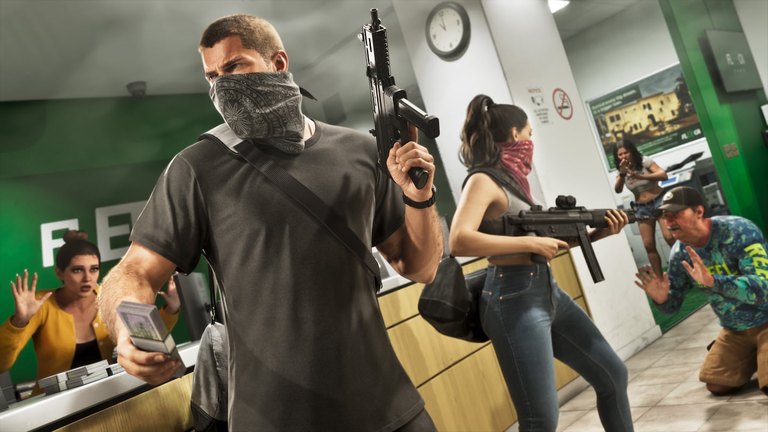
The small stickups make terrific use of the pair. Somebody has to watch the customers while somebody else collects the money. Once there’s enough in the bag to make the job worthwhile, every extra moment inside belongs to the person who wants a little more. It’s an unusually good way of putting greed in a player’s hands. A bigger number on a results screen is nice. Getting both people outside while a quiet exit is still possible feels like a reason to leave money on the counter.
As their prospects improve, better equipment opens up more ambitious targets. Some jobs require cash up front, and the game leaves you room to earn it. A stolen car with a buyer waiting is an evening’s business in its own right. So is a trip to a dealer’s trailer to steal his stock. It helps that these crimes have a purpose beyond filling out a list on the map. If you’re saving up for a particular job, you get to decide how much additional trouble it’s worth getting into tonight.
In a shootout, the Focus ability slows time enough to pick a shot from cover. A hit to a limb can put an enemy down alive. That’s a welcome bit of latitude for a crime game in which pulling a trigger used to feel like a fairly final decision. It gives the leads room to be selective about who gets hurt, and the fighting is forgiving enough to let a player make that choice under pressure. If what you want from a shooter is the difficulty of making the shot itself, Focus takes some of the sport out of it.
Rockstar is less generous with that freedom inside some of the story missions. A nightclub sounds promising until the assignment turns out to involve escorting a rich bore around it at his walking speed. In one infiltration sequence, the crew rigs a line in a cutscene, the player holds the stick to descend, and another cutscene takes over. Holding the stick feels like a job invented for the player while the director sets up the next shot.
The big set pieces do sometimes justify that firm hand. A hospital escape gives the pair more pressing business than following instructions politely. Switching between two people on different parts of a job also lets the game do its own editing. A vault can occupy Lucia while Jason deals with trouble elsewhere, and the player has a stake in getting back to both. There’s real pleasure in having two things going wrong at once and a hand in fixing both of them.
An evening off in Leonida
Outside a mission, even an advertisement can be worth pulling over for. A farm has a sign looking for a pilot. Creative Bloq’s Ian Dean took the job and got involved in a side story about meth and strawberries. Elsewhere, flyers turn up people you can call. A number in the phone is an invitation you can put off until tomorrow. That’s a small courtesy in a state this keen to get you into trouble on the way to somewhere else.

It’s also a place where having a car of your own makes sense. Leave spare clothes and long guns in it and you’ve made a decision about what you’ll have to hand when a job goes wrong. Changing clothes can throw off police looking for a particular outfit. Getting straight back into a car they recognize can put you in trouble again. By the time the chase is over you may have good reasons both to fetch that car and to leave it exactly where it is. The scooter service on the phone can bring it back when you want it.
Traffic is a less persuasive use of anybody’s free time. Switch on automatic driving and the car will obediently wait at a light. If you actually want the journey over with, RydeMe charges extra to skip it, and a driver can still drop you short of a destination out in the wetlands. The car radio goes some way toward redeeming a long trip. A couple of stations play ’80s rock, which is just about the right company for an open-top car in the Keys at dusk. On the third run across town for the same employer, the extra fare starts to look cheap.
I’d recommend GTA VI to anyone happy to call a small robbery and a drive home a full evening’s play. The Guardian’s Keza MacDonald spent about seventy hours getting to the end, thirty of them before she even reached Vice City. At three hours a week, that’s ten weeks just to reach Vice City at her pace.
Sources
This appraisal draws on the following hands-on reviews of the single-player campaign.
- Ars Technica · Home life and the relationship meter
- The Guardian · Jason, Lucia and the length of the campaign
- MobileSyrup · Heists and scripted missions
- Game Informer · Combat and mission direction
- Creative Bloq · Character switching and roadside jobs
- TechRadar · Cars, equipment and the Keys
- Famitsu · Traffic, the radio and the paid ride (Japanese)